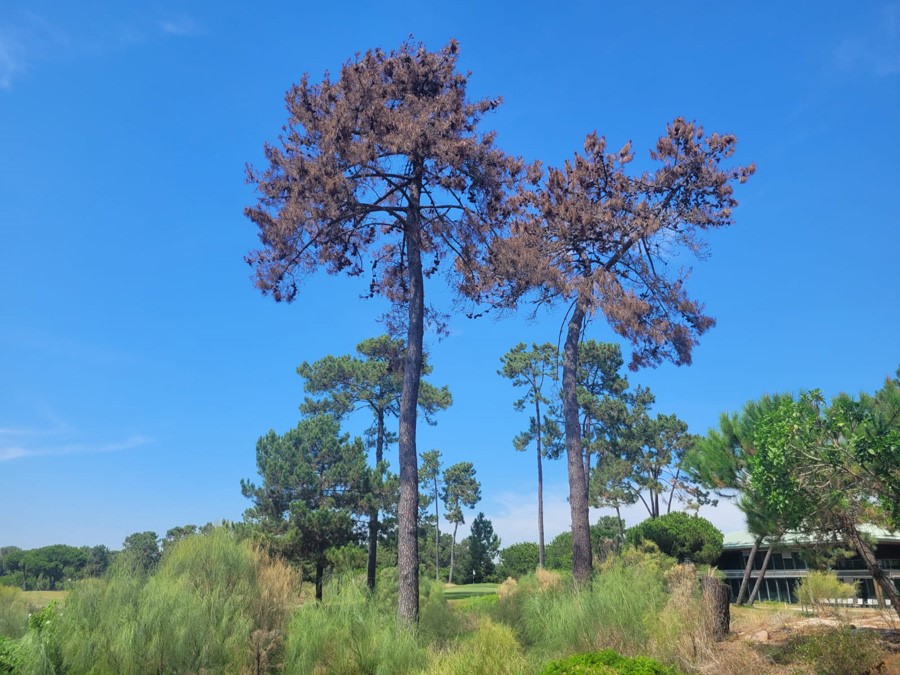
The pinewood nematode (PWN), Bursaphelenchus xylophilus, is a highly damaging pathogen of pine trees. Maritime pine (Pinus pinaster), in particular, has been shown to be extremely susceptible, and declining trees in the field typically harbor high nematode densities. Yet, as highlighted by recent work, forest decline cannot be attributed to the PWN alone: disentangling its direct effects from those of other biotic and abiotic stressors remains difficult. Pine wilt disease (PWD, Figure 1) emerges instead as a multifactorial phenomenon shaped by pathogen biology, vector dynamics, forest community interactions, and climate.
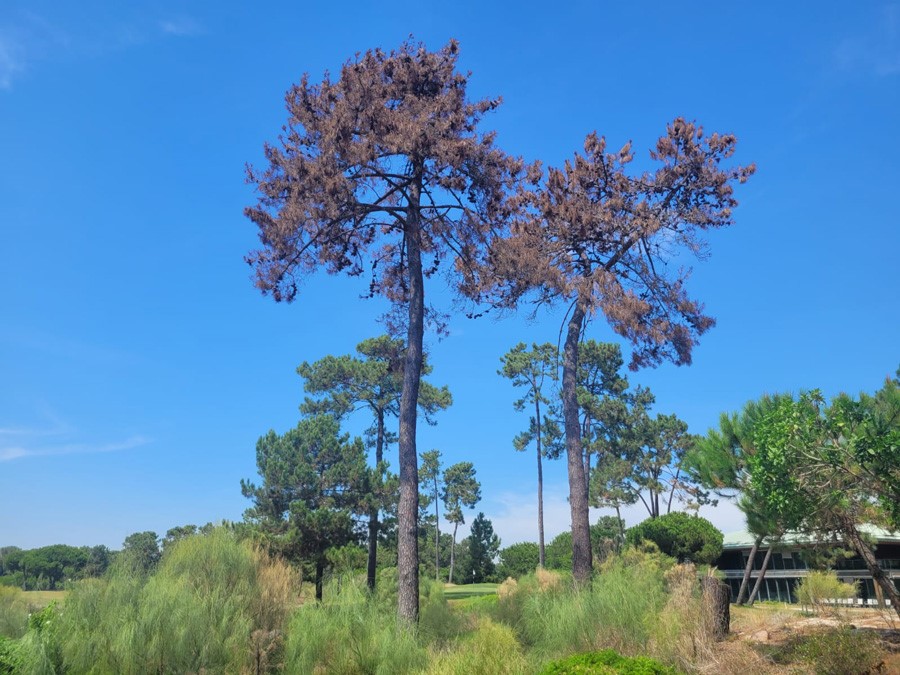
Figure 1: Maritime pines exhibiting symptoms of pine wilt disease.
Despite this complexity, European containment and eradication strategies have remained largely unchanged for nearly three decades, relying primarily on the detection and removal of wilting trees and on assumptions about the dispersal capacity of the Monochamus vector (pine sawyers). While these measures offer operational simplicity, they have been widely criticized for resting on uncertain estimates of vector transmission and dispersal and for overlooking key aspects of PWN biology. These include the nematode’s capacity to persist in asymptomatic trees, variation in virulence, the possibility of alternative saprophytic life histories, and strong interactions with climate. Drought, in particular, exacerbates PWD severity and is expected to intensify under climate change, threatening to overwhelm containment systems, as has already occurred in the recent past.
Vector-focused control has also tended to ignore ecological context. Community interactions strongly influence Monochamus abundance within declining trees, and pine sawyers are often far less common than assumed, occurring in fewer than one third of declining pines in southwest Portugal. This suggests that strategic, targeted salvage of high-risk trees could substantially reduce PWN spread while removing only a fraction of affected trees, lowering costs and system overload. However, such approaches require a deeper understanding of vector host preferences and nematode phoresy.
More broadly, PWD management reflects a familiar problem in forest disturbance policy: reliance on static, containment-oriented tools that prioritize documentation of damage over prevention. After 27 years, millions of euros invested, and the inevitable spread of the PWN from Portugal to Spain and now France, it is increasingly clear that diagnostics and clear-felling alone are not enough. As Asia has advanced host resistance and biological control research, Europe has hesitated to accept that PWN is no longer an eradication problem, but a permanent one.
Moving forward, Europe must transition from delay tactics to long-term, adaptive management. Integrating “One Health” principles, by identifying reservoirs, revising pathogen life histories, accounting for long-distance dissemination pathways, and updating forecasts under changing climate and land use, offers a way to align science, policy, and prevention.
David Pires
References :
Carla S. Pimentel, David Pires, João Campôa, Jordana Branco, Raquel Marques, Manuel M. Mota & Teresa Calvão
– Multiple factors associated with forest decline in the context of control measures for the pinewood nematode | European Journal of Plant Pathology | Springer Nature Link