
After the recent webinar organised by IEFC and the new task force on Stand Complexity in Planted Forests together with the IUFRO Research Unit – 1.03.00 – Short-Rotation Forestry (SRF), a bit of an update on the status of the within-species diversity that is planted is needed to clarify how NZ exotic planted forests are managed. Pinus radiata or radiata pine, is an introduced exotic tree species that comprises ~90% of the planted forest in New Zealand. While the very top genetic selections are deployed as clones, within-species diversity is always at the top of the mind. This is because biosecurity and the possibility of pests or diseases disrupting the planted forest estate is a critical factor in how our forests are managed.
New Zealand has a strong history of management of genetic diversity. Between 1971 and 1985, around 36 parent genotypes contributed to establishing about 28% of the existing planted forest resource, and a further 20% was established with seed orchard progeny of 120 progeny-tested parent genotypes between 1985 and 1993 (Carson 1997). This continued, with the advent of clonal forestry being only a small part of the forest compared with seedling forestry (Sorensson and Shelbourne 2004). Since this time, the principles of within-species diversity have remained very conservative. New Zealand seed orchards have consistently met and mostly exceeded the guideline of a minimum of 20 unrelated genotypes (Lindgren and Prescher 2005). This is a benchmark that reflects international best practice.
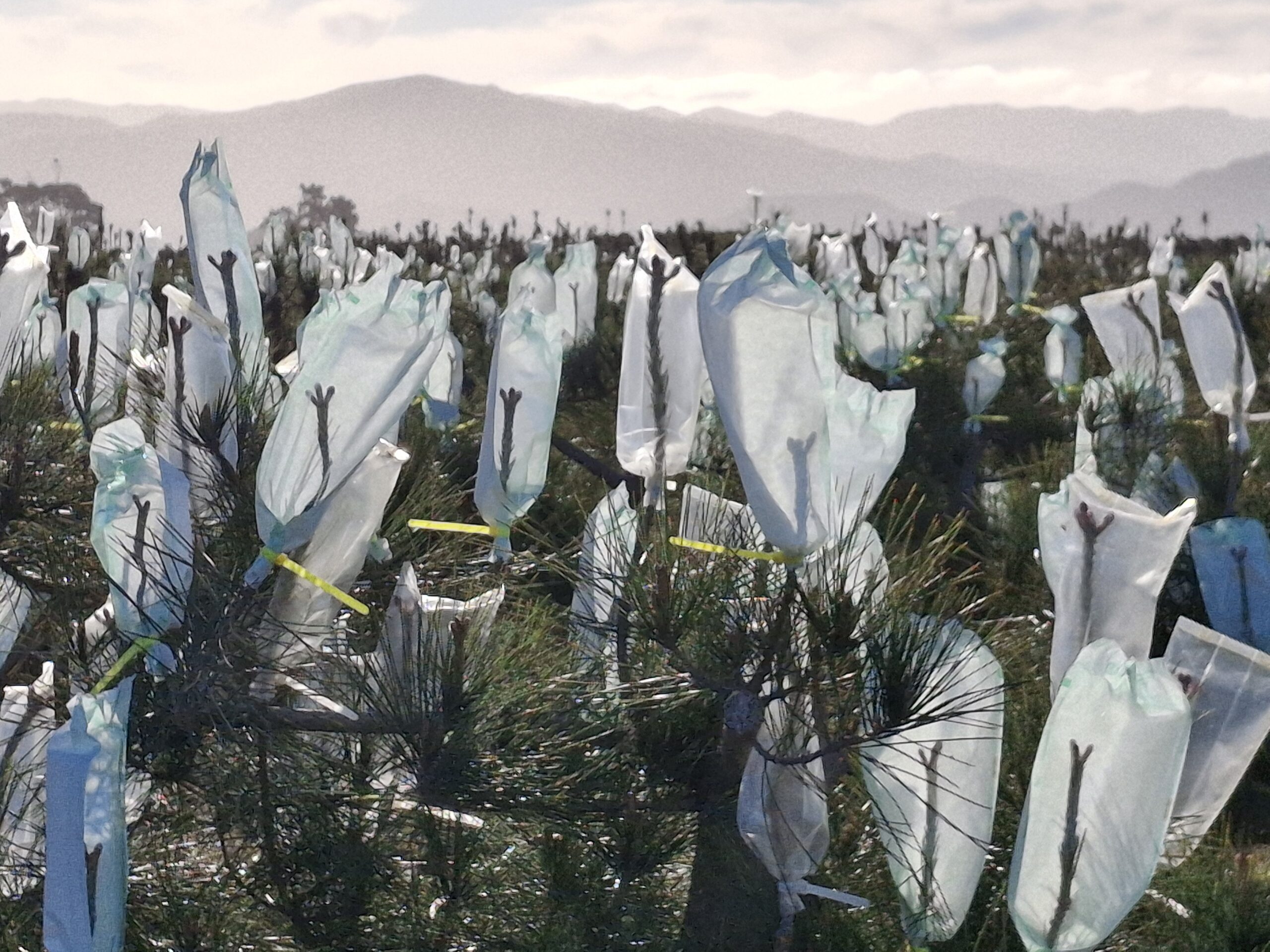
Control-pollinated radiata pine seed orchard in New Zealand
Today, the breeding of radiata pine is managed by the Radiata Pine Breeding Company (https://rpbc.co.nz). Conservation of genetic diversity is a core strategy for the company, with five genetic conservation archives maintained at geographically distributed locations. These archives ensure a large gene pool is available for breeding and deployment when required.
In 2024, a national nursery survey data indicated that about 89% of radiata pine is planted from field-grown seedlings and ~11% are containerised (which includes cuttings/clones). In short, there remains a significant amount of genetic variation, even within the radiata pine planted forest estate in New Zealand.
For further information on radiata pine genetics and breeding, visit the Radiata Pine Breeding Company at rpbc.co.nz.
Heidi Dungey, Natalie Graham & Grahame Stovold
Recommended reading:
Aimers (2024). Review of Planting Stock Quality and Performance. Forest Growers Research report Number PSP-TR005. 65pp. https://fgr.nz/wp-content/uploads/2024/10/PSP-TR005-Review-of-Planting-Stock-Quality-Performance-JAimers.pdf?utm_source=chatgpt.com
Bayne, K. (2021). Covid-19: Extending the planting season – Industry Survey. (2022/08). Rotorua: Scion/Te Uru Rākau – New Zealand Forest Service. https://www.mpi.govt.nz/dmsdocument/51610-Results-of the-industry-survey-on-extending-the-planting-season.
Carson (1997). FRI Research on genetic diversity as a component of biodiversity of forests. NZ Forestry: 14-16.
Lindgren, D. and Prescher, F. (2005). Optimal clone number for seed orchards with tested clones. Silvae Genetica 54: 80-92.
Sorensson, C. T. and Shelbourne, C. J. A. (2004). Clonal Forestry. Chapter 11, Tree Breeding and Genetics in New Zealand. Springer online 2019. Pp 97-106.