Boreal conifer forests face increasing climate-related stress that threatens their productivity and resilience. In productive forests, sustainable forest management must therefore focus not only on timber production but also the preservation of genetic diversity – the foundation of adaptability. Scots pine (Pinus sylvestris L.), a key species in northern European forestry, has long been the focus of systematic tree breeding. Understanding how the use of improved genetic material affects genetic diversity is essential for ensuring the long-term stability of future forests.
Research carried out within the Latvian National Research Programme No. VPP-ZM-VRIIILA-2024/2-0002 “Innovation in Forest Management and Value Chain for Latvia’s Growth: New Forest Services, Products and Technologies (Forest4LV)” at the Latvian State Forest Research Institute ‘Silava’ addressed this question through simulation modelling and field studies. The results show that genetically improved material can be widely used to increase productivity without threatening genetic diversity, provided that seed sources are applied in a balanced way.
Simulation analyses tested different reforestation strategies at landscape level, varying both the proportion of Scots pine regeneration established with seed orchard material (0–100%), and the number and clones in the contributing orchards. Several hundred naturally regenerated trees and seed orchard material (representing from 20 up to over 200 clones per orchard) were genotyped to serve as simulation dataset. The results suggest that even if planted Scots pine stands dominate future regeneration, landscape-level genetic diversity can remain comparable to that of natural regeneration as long as several orchards with diverse clonal composition contribute. Even when using seeds from orchard with the fewest clones (20), expected heterozygosity remained at 95% of that in pure natural regeneration when up to two thirds of the total simulated pine forest area was planted.
The analyses also indicated that second-generation seed orchards, even when based on fewer clones, can maintain diversity comparable to larger first-generation orchards (e.g., 25 vs 90 clones) when their parent trees represent a wide geographic range. Both the number of parents and their origin are therefore crucial for maintaining adaptability under changing conditions.
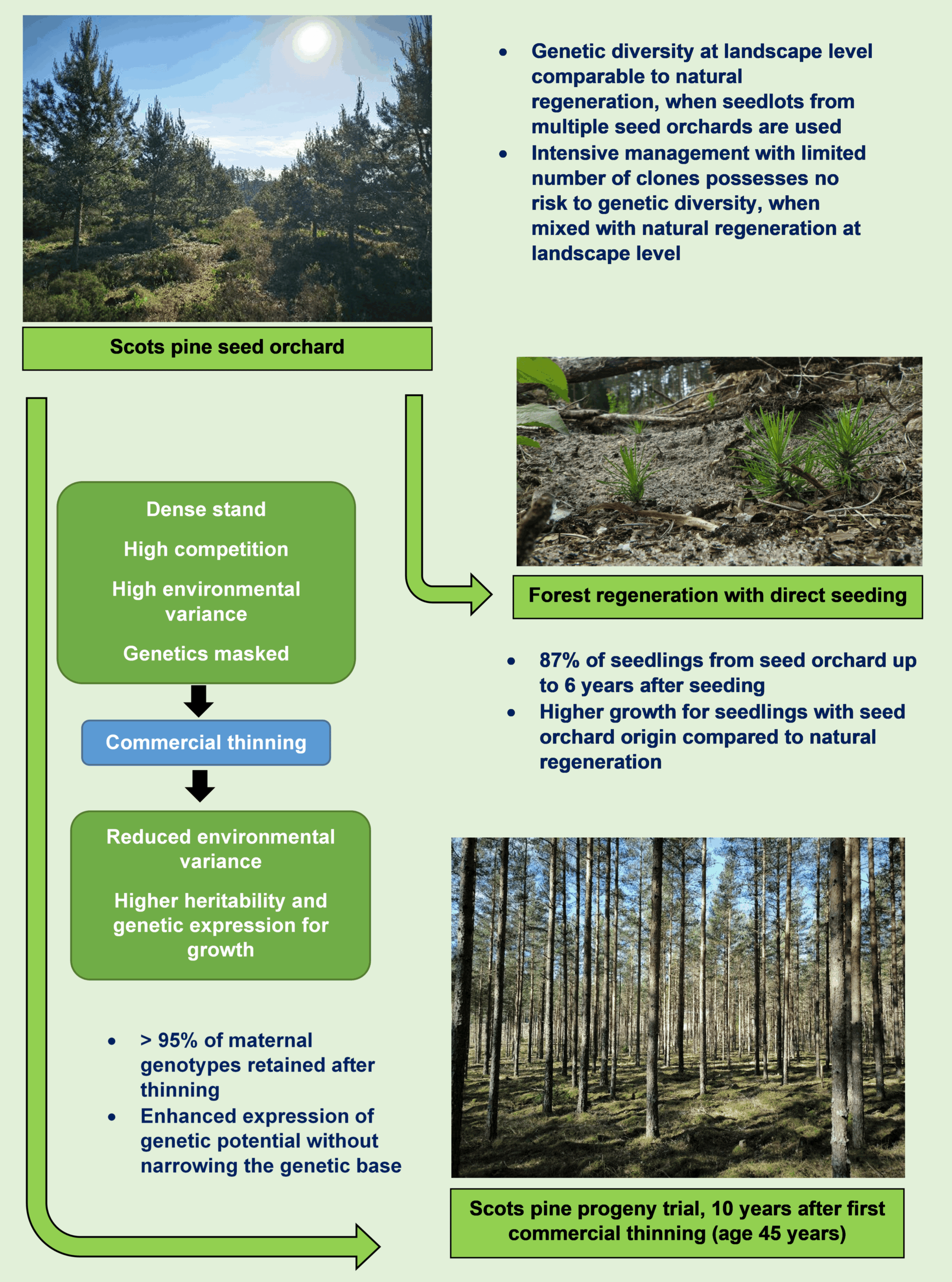
Field studies supported the findings with evidence of performance of seed orchard material during the rotation. In trials of mechanised direct seeding on organic soils, improved material performed well. Genetic analyses showed that 87 % of seedlings originated from the seed orchard 6 years after seeding, and these seedlings were taller and more vigorous, with their advantage increasing as stands aged. This demonstrates that improved seed material remains genetically dominant and growth-effective even in challenging environments.
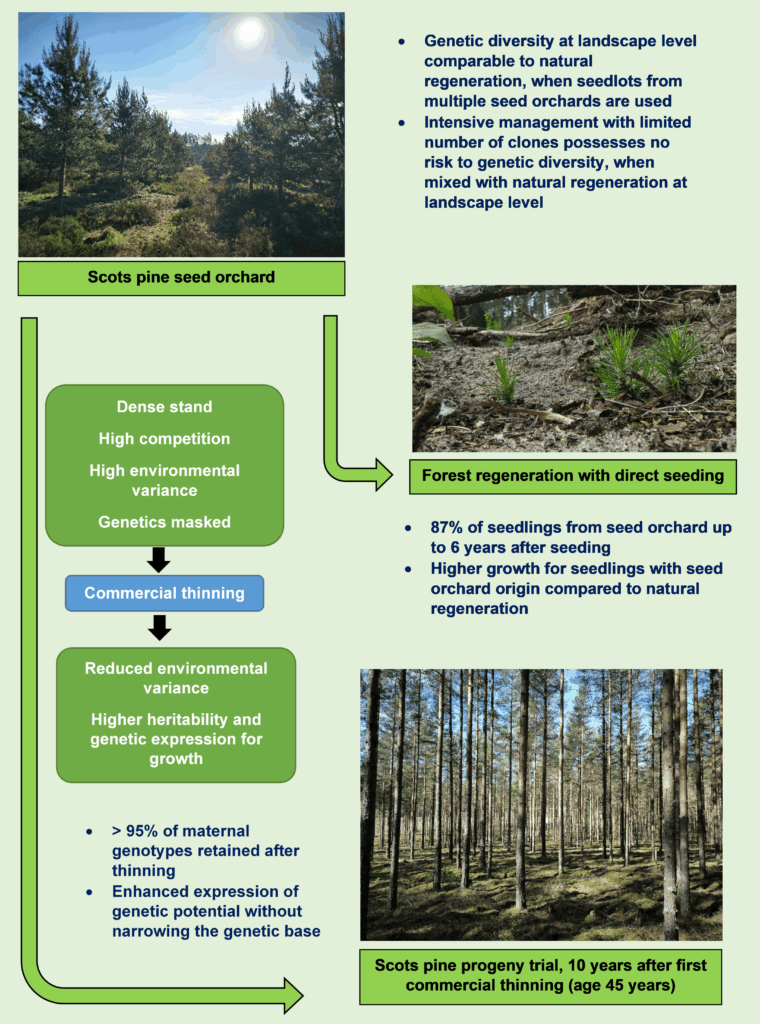
Figure 1: Key research tasks on Scots pine genetic diversity within the the Latvian National Research Programme Forest4LV, combining simulation modelling and field studies of improved reproductive material
Long-term progeny trials provided further confirmation from older stands. After the first commercial thinning at 30–40 years of age – which removed up to half of the stand basal area – more than 95 % of maternal genotypes were retained, and heritability for growth increased. Thinning therefore enhanced the expression of genetic potential without narrowing the genetic base.
Together, these studies show that genetically improved Scots pine can combine productivity and genetic diversity, ensuring adaptability. Using seedlots from multiple orchards across the landscape ensures that large-scale reforestation with improved material strengthens, rather than reduces, the resilience of future forests.
Pauls Zeltiņš

More about the research project: www.silava.lv