Skip to content

+330535385257

European Institute of Planted Forest – IEFC

European Institute of Planted Forest – IEFC

The multi-actor network for sustainable management and resilience of planted forests

  • Homepage
  • About us
    • History
    • Mission
    • Team
    • Governance
      • Status and Governance
      • General Meetings
    • Career Opportunities
    • Support IEFC – Make a donation
  • Members
    • Our members
    • Login IEFC Members
    • Become a member
  • Infrastructures
    • Network of plots
    • Digital Infrastructures
      • Silvalert
      • Formodels
      • Tree Data
    • Living Labs
  • Networking
    • Webinars
      • Webinars IEFC
        • Douglas Fir health: insights from Europe
        • Genetic Resources and Short-Rotation Forestry Complexity
        • Webinars Replays – Let’s Talk About Planted Forests
      • Webinar on European Projects
        • FIRE-RES – Innovation Actions
    • IEFC General Assembly 2025
      • Information
      • Tentative Agenda
      • Presentations
    • Next Events
    • IPC 27th Session
      • Abstracts
        • Soumission des Résumés
        • Book of abstracts IPC 2024
      • Registration
        • General Registration
        • Pre-Study Tour Registration
        • Post-Study Tour Registration
      • Agenda
        • Provisional Agenda
        • Provisional Pre-Study Tour Program
        • Post Study Tour Program
      • Practical information
    • IEFC – Network fund 2025
  • Projects
    • IEFC Projects
  • Media Library
    • Communication
      • Logo & Graphic Charter
      • IEFC Press
        • Press Kit
        • Press Review about IEFC
        • Press Releases
        • Media Toolkits
      • IEFC Newsletters
        • Subscribe To IEFC Newsletter
        • Our Latest Newsletters
    • IEFC Library
    • Resource Centre
    • Educationnal Materials
    • IEFC Publications
    • Presentations And Papers
  • gb
    • fr
    • es
    • pt
xClose Menu
Home/Biotic, Risk management/Polyphasic approach to the selection of Esteya isolates for the control of the pinewood nematode, Bursaphelenchus xylophilus

Polyphasic approach to the selection of Esteya isolates for the control of the pinewood nematode, Bursaphelenchus xylophilus

29 January 2025 comm IEFC 0 Comments 0 tags

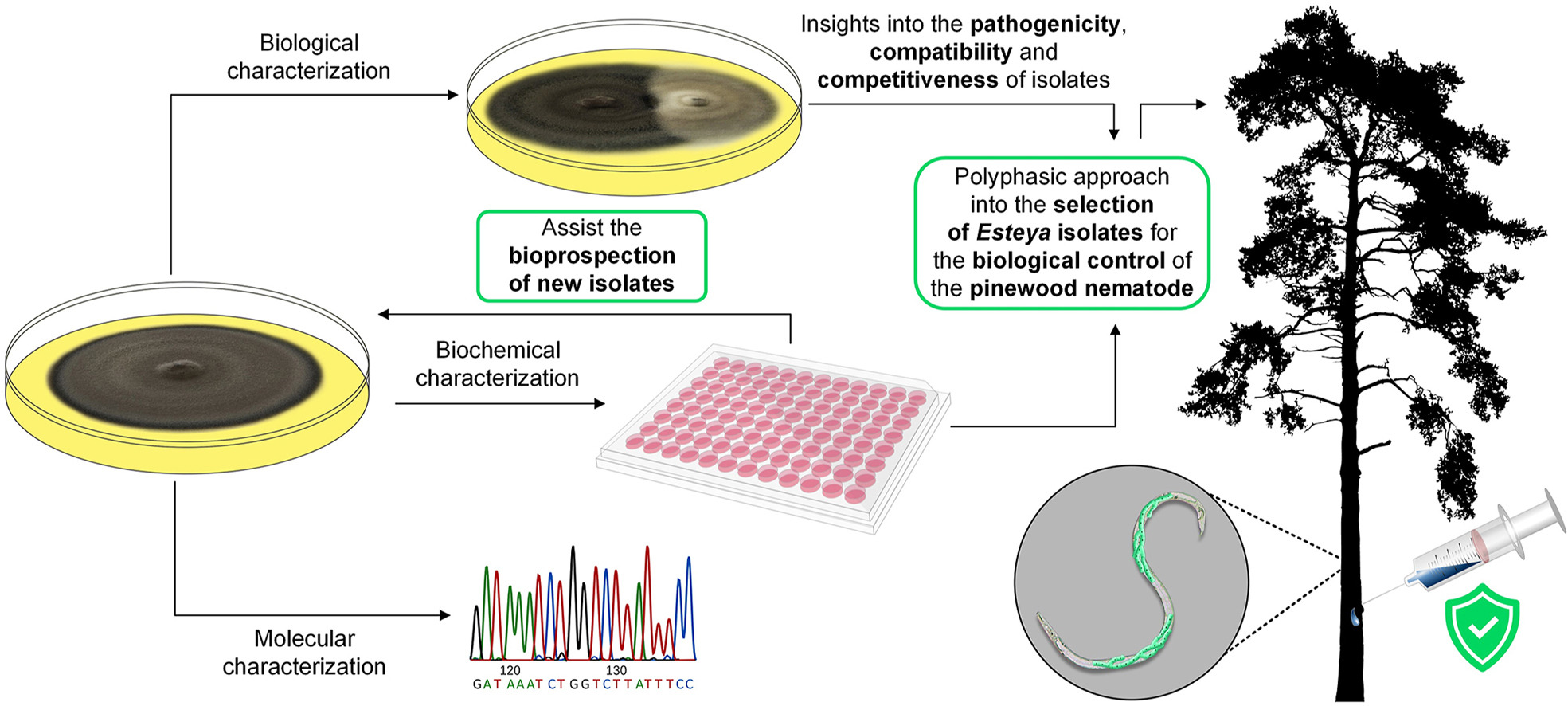
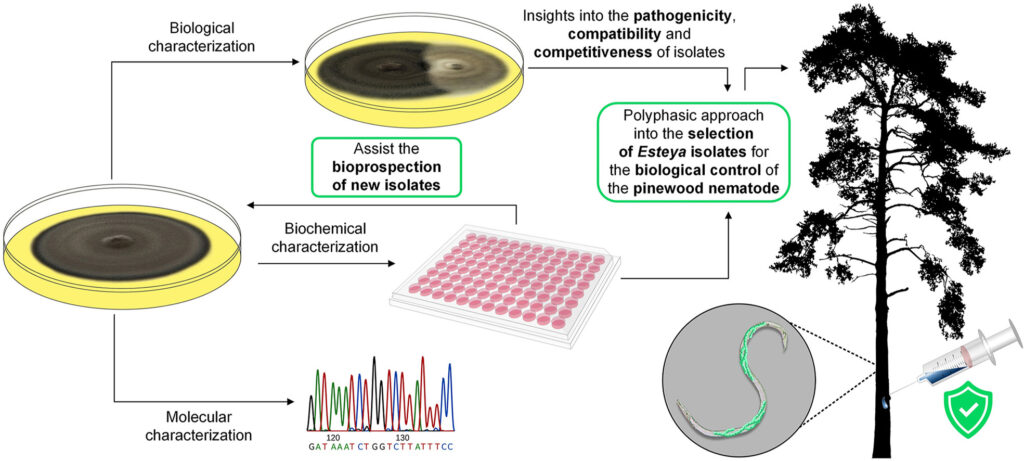
Pine wilt disease, caused by the pinewood nematode, Bursaphelenchus xylophilus, is a major phytosanitary concern to pine forests worldwide. Managing pine wilt disease involves a complex logistical undertaking, with limited effectiveness and significant ecological repercussions. An increasing demand for biosolutions has sparked an interest in microbial antagonists capable of controlling the nematode. Esteya spp. are promising fungal biocontrol agents of the pinewood nematode. Here, we carry out an integrative characterization of Esteya vermicola and Esteya floridanum isolates, through biological, biochemical, and molecular methods, and provide insights into the selection of these isolates for the biological control of the pinewood nematode. Dual culture assays revealed that Esteya spp. can compete with ophiostomatoid fungi (Leptographium terebrantis and Ophiostoma ips) occurring in the pathosystem of pine wilt disease, an often-neglected ecological perspective that could hinder their success as biocontrol agents. Moreover, E. vermicola can metabolize more carbon sources than E. floridanum, which can have implications on their successful establishment in pine trees. Our experimental approach further shows that both Esteya spp. are equally competent in suppressing the pinewood nematode in vitro. Overall, our results suggest that a prophylactic application of Esteya in pine trees may be preferable for optimal bioprotective effects against the pinewood nematode and fungal pathogens.

The link to the paper: https://doi.org/10.1016/j.funbio.2024.10.001

David Pires, PhD Candidate

Post navigation

Previous PostPrevious
Next PostNext

Archieves

  • November 2025
  • June 2025
  • May 2025
  • March 2025
  • January 2025
  • Categories

  • Bioeconomy
  • Associate members
  • Members
  • Recent Posts

    • Introduction of the pinewood nematode in France: what can research do?
    • english test
    • Editorial 2026
    • Webinar – Let’s Talk About Planted Forests – 28 November 2025
    • IEFC General Assembly 2025 in San Sebastián

    Search

    ©IEFC Copyright ©2025 Tous droits réservés