On 3 November 2025, the pine wood nematode (Bursaphelenchus xylophilus) was officially detected for the first time in France. This first detection was in a forest stand in the municipality of Seignosse, nearly 600 km from the last known sites of contamination in Spain, in the region of Galicia. This nematode, native to North America, was first introduced to Portugal in 1999, then detected in Spain in 2008, 2010, 2016 and 2018, leading to heavy eradication measures in accordance with European guidelines. It was therefore only a matter of time before the worm spread to the Landes de Gascogne forest, an area that is particularly vulnerable due to the exceptional size and continuity of its maritime pine forest. The host species is Monochamus galloprovincilis, a longhorn beetle that acts as a vector for the nematode and is naturally present in France. But despite the preparations made by the forestry sector and forest health authorities for this eventuality, the announcement of the nematode’s arrival in France is a source of great concern for professionals.
The nematode probably arrived in France in the spring of 2025, causing the rapid death of infected trees. The challenge for the coming winter period is to prevent the contamination of new insect vectors that could spread next spring and extend the epidemic to the rest of the Landes forest. To do this, all symptomatic trees must be detected and treated before the emergence of Monochamus larvae that may be present. The prefectural decree of 4 November 2025 defined an infested zone and a buffer zone with a radius of 500 metres and 20 kilometres respectively around the outbreak, where measures to eradicate the nematode and restrict forestry activities are being applied, in accordance with European regulations and the national control plan. The DSF has stepped up sampling to detect new outbreaks of infection, and professionals are ready to destroy positive specimens by grinding or autoclaving the wood. In the context of this crisis what can scientific research contribute to support the field efforts of professionals in the sector?
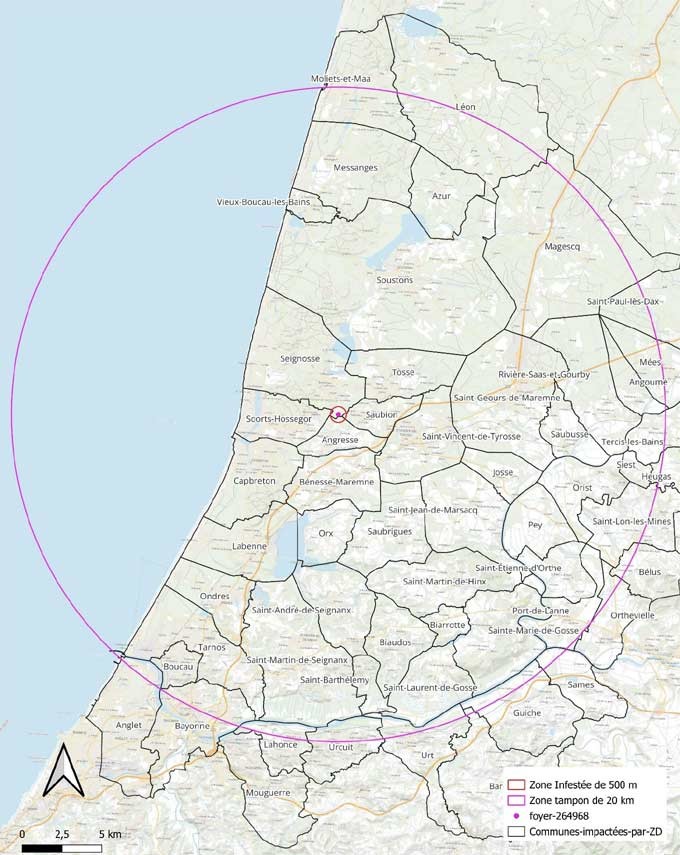
Figure 1: Figure 1: Map of the demarcated area of the pine nematode outbreak, DRAAF Nouvelle-Aquitaine, 04/11/2025
Numerous studies have been conducted over decades to improve understanding of the dynamics of propagation in Portugal, the detection capacity of the vector and the nematode, and also to better understand the sensitivity of different conifer species to the nematode and the possibilities of acquiring resistance through genetic improvement. New technologies also show promise in making the methods for detecting and monitoring forest pests faster and more effective. This is the subject of the European research project FORSAID, which began in 2024 under the coordination of the University of Padova and in which the IEFC and INRAe are partners. This project, which brings together research institutes and private companies from 10 countries, aims to develop new technologies, including AI, for the identification, detection and monitoring of European quarantine pests. The pinewood nematode, classified as a priority quarantine pest by the European Commission, is one of the organisms targeted by the project. The latter immediately adapted the schedule of its research activities to respond quickly to this health issue.
The project will therefore carry out a number of research activities to develop the range of monitoring tools available to stakeholders in the sector. Artificial intelligence models will be applied to remote sensing data to locate dying trees more quickly over large areas. A flight carried out immediately after the prefecture announced the discovery of the pathogen in the contaminated area enabled an orthophoto to be collected in order to apply this method and support forest protection services. Smart traps coupled with advanced image analysis are being developed to automate the detection, sorting and transfer of capture data for target insects, including Monochamus. Tests are being carried out to automate molecular detection procedures such as metabarcoding from environmental DNA samples (canopy, trunk, trap), which would make detection faster and more sensitive to low levels of pest DNA concentration. The role of participatory science as a complement to traditional surveillance tools will also be explored in greater depth. A study has shown that 50% of the first detections of exotic species were made by participatory platforms before or during the year of official detection (Gonzalez-Moreno et al. 2024). The IEFC continues to contribute to this effort by maintaining the Silvalert application and associated computer server, which recorded new spontaneous reports of pine decline by its users in November.
Finally, the IEFC is responsible for coordinating the European project stakeholder committee, which brings together actors involved in monitoring forest health in Europe, such as forest managers and owners, nursery operators, customs inspectors, policy makers and, above all, plant protection organisations. This multi-stakeholder approach should enable the project’s progress to be discussed with those working in the field to ensure that their expectations are taken into account and to maximise the impact of these new tools. The nematode crisis in France is therefore a new opportunity for the IEFC to carry out one of its main missions: to strengthen synergies between research and those working in the field to ensure the resilience of planted forests in Europe.
Benoît de Guerry
References:
Christelle Robinet, Nicolas Mariette, Hoël Hotte, Marie Grosdidier, Hervé Jactel et al. Invasion risk of the pine wood nematode in France. The Future Prospect of Management Strategy on Pine Wilt Disease, National Institute of Forest Science (NIFoS), South Korea, Oct 2023, Seoul (Korea), South Korea. hal-04277094
Díaz, R., Frade, S. Current situation of the pine wood nematode in Galicia (Spain). IEFC’s newsletter of June 2025. https://www.plantedforests.org/current-scenario-of-the-pine-wood-nematode-in-galicia-spain/
Regional Directorate for Food, Agriculture and Forestry. Decree establishing a restricted zone following the detection of Bursaphelenchus xylophilus, pine wood nematode, in the Landes department. 4 November 2025. https://draaf.nouvelle-aquitaine.agriculture.gouv.fr/IMG/pdf/ap_raa_33_special_no2025-286.pdf
González-Moreno, Pablo & Anđelković, Ana & Adriaens, Tim & Botella, Christophe & Demetriou, Jakovos & Bastos, Rita & Bertolino, Sandro & López Cañizares, Celia & Essl, Franz & Fiser, Ziva & Glavendekić, Milka & Herremans, Marc & Hulme, Philip & Jani, Viola & Katsada, Dimitra & Kleitou, Periklis & La Porta, Nicola & Lapin, Katharina & López-Darias, Marta & Pocock, Michael. (2024). Citizen science platforms can effectively support early detection of invasive alien species according to species traits. People and Nature. 7. 278–294. 10.1002/pan3.10767.