The final conference of the European FIRE-RES project, entitled “Towards a Wildfire-Resilient Europe: From Knowledge to Policy Action”, was held on 4 and 5 November 2025 in Brussels. This major event brought together more than 120 participants – policy makers, MEPs, scientists, practitioners, NGOs and representatives of civil society.
In addition to presenting the results of four years of work, this meeting brought together scientific expertise, operational needs and political priorities in a common roadmap for a Europe that is better prepared for extreme fires.
In this context, the Nouvelle-Aquitaine Living Lab, coordinated by IEFC, has worked on numerous topics integrating fire risk management in its prevention, control and restoration phases.
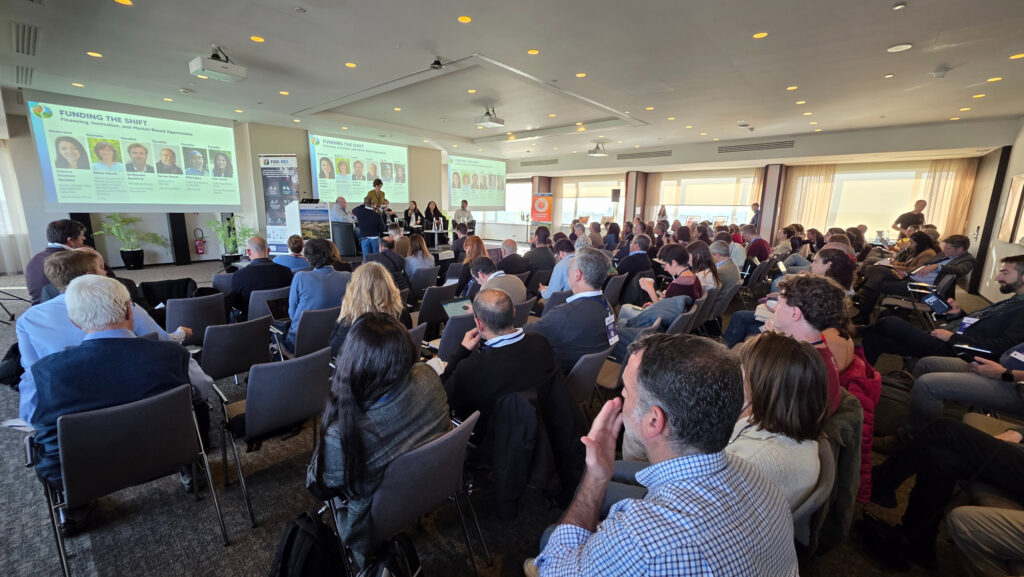
© Photo credit: FIRE -RES / Presentation of speakers at the FIRE-RES meeting round table
A Living Lab focused on collective action
Throughout the project, the Living Lab brought together a wide range of stakeholders: firefighters, scientists, forest managers, elected officials, government departments, associations and residents.
The CRIFF meetings provided a valuable forum for comparing needs, discussing possible solutions and improving coordination between institutions. This process began in 2021 with the development of a joint roadmap with the members of the Living Lab in order to determine which of the project’s 34 innovative actions were most relevant to test in our territories.
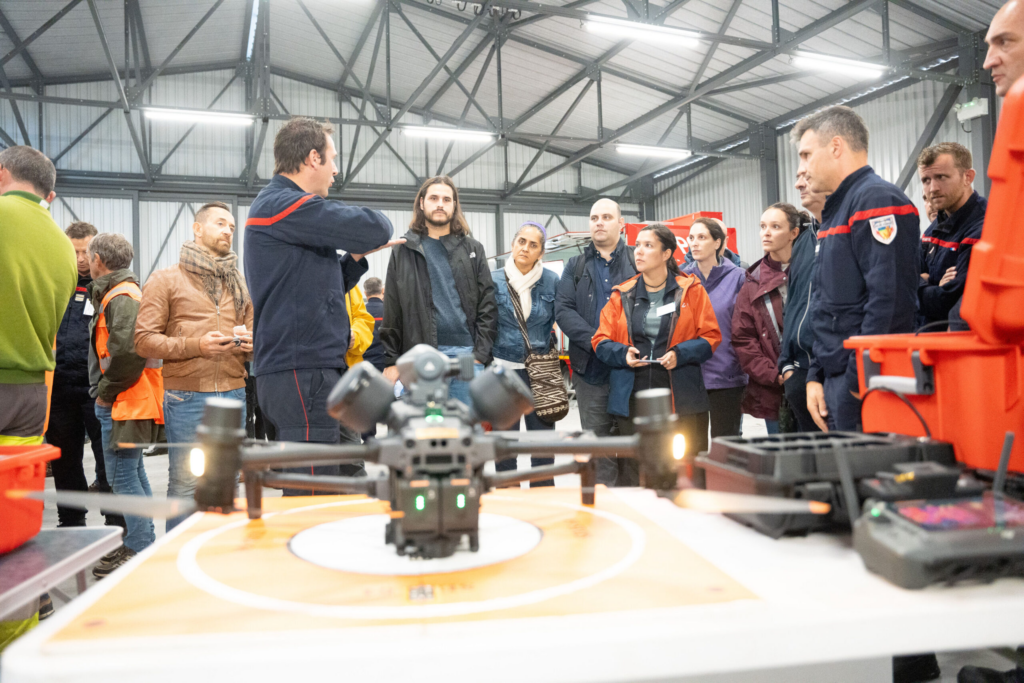
© Photo credit: FIRE -RES / FIRE-RES Tour in Mimizan during the general meeting from 8 to 10 October 2024
Better understanding the territory to better anticipate
INRAE launched the project in 2021 by working on the implementation of the FIRELIHOOD model, which enables daily and weekly fire risk assessments to be carried out, as well as long-term trends to be predicted.
One of the project’s major undertakings in the region was to improve knowledge of forest fuel. By combining LIDAR data processed by INRAE in Avignon, field observations made by IEFC, ONF and local experts, a new catalogue of fuel types in the Landes forest was published. This resource will enable regional fuel maps to be refined and serves as a precursor to the national fuel map currently being prepared by INRAE. These maps, used in fire spread models, have become essential for optimising fire planning and control.
For example, the project has made it possible to virtually explore several landscape reorganisation scenarios to test the effect of different forest configurations and developments: connected forest areas, aligning strategic breaks, agricultural areas, photovoltaic parks, recreational areas, and other land uses with low fuel loads, it is possible to reduce the risk of fire and make the territory more resilient to extreme fires such as those experienced in 2022. To access the pre-published version of the article, click here.
In addition to the compartmentalisation of the forest, the areas where human habitat and forest meet represent one of the most sensitive points of vulnerability. As part of FIRE-RES, several approaches have been taken to involve local authorities and raise their awareness of these two components:
• Meetings were organised with local authorities (elected representatives and/or residents) to present the behaviour of a fire similar to that of 2022 in their municipality and to consider how to integrate the risk into local planning.
• Organisation of a policy clinic to define regulatory adjustments that would enable local elected officials to develop their territory with a view to compartmentalising the forest and creating safer urban interfaces.
• Creation of mental models to target communication in order to improve fire risk culture in the living laboratory area.
• Reminder of the mayor’s role and reflection on optimising regulatory brush clearing.
These actions have helped to strengthen risk culture among elected officials, technicians and residents, which is essential in an area where fire pressure is changing rapidly.
Other innovations have been tested, such as parametric insurance, autonomous fire detectors for specific outdoor spaces, smoke modelling tools to anticipate evacuations, real-time meteorological data analysis tools, and risk modelling that takes these issues into account.
A flame to keep alive beyond the project
Although the FIRE-RES project will come to an end in November 2025, the momentum it has generated will continue. The tools developed, the partnerships initiated and the data produced by the living laboratory will continue to support stakeholders in the massif in their deliberations and future decisions. Thanks to this collective effort, the region now has a solid foundation for moving towards more resilient landscapes that are adapted to the challenges posed by climate change and extreme fires. The European project coordinator (CTFC) wishes to maintain the network of 11 European living laboratories, and structuring initiatives are being put in place around action research in Nouvelle-Aquitaine. The IEFC will ensure that it capitalises on these four years of work by keeping in touch with all the members of the living laboratory to maintain its coordination while awaiting funding to resume the actions initiated.
To find out more about FIRE-RES, and more specifically about the actions carried out in the Nouvelle-Aquitaine Living Laboratory, please visit our dedicated page.
Lucas Moreews and Christophe Orazio, IEFC