Skip to content

+330535385257

Instituto Europeo Del Bosque Cultivado – IEFC

Instituto Europeo Del Bosque Cultivado – IEFC

La red para la gestión sostenible y la resiliencia de los bosques cultivados

  • Página de inicio
  • Quiénes somos
    • Historia
    • Misión
    • Equipo
    • Gobernanza
      • Estatus y gobernanza
      • Asambleas Generales
    • Oportunidades profesionales
    • Apoye a IEFC
  • Miembros
    • Nuestros miembros
    • Iniciar sesión Miembros de IEFC
    • Hazte Miembro
  • Infraestructuras
    • Red de Parcelas
    • Infraestructuras Digitales
      • Silvalert
      • Formodels
      • Tree Data
    • Laboratorios Vivientes
  • Redes
    • Webinars
      • Webinars IEFC
        • Douglas Fir health: insights from Europe
        • Genetic Resources and Short-Rotation Forestry Complexity
        • Webinars Replays – Let’s Talk About Planted Forests
      • Webinar on European Projects
        • FIRE-RES – Innovation Actions
    • IEFC General Assembly 2025
      • Information
      • Tentative Agenda
      • Presentations
    • Próximos Eventos
    • IPC 27th Session
      • Abstracts
        • Soumission des Résumés
        • Book of abstracts IPC 2024
      • Registration
        • General Registration
        • Pre-Study Tour Registration
        • Post-Study Tour Registration
      • Agenda
        • Provisional Agenda
        • Provisional Pre-Study Tour Program
        • Post Study Tour Program
      • Practical information
    • IEFC – Fondo de red 2025
  • Proyectos
    • Proyectos IEFC
  • Biblioteca Multimedia
    • Comunicación
      • Logotipo y carta gráfica
      • Prensa IEFC
        • Dossier de Prensa
        • Revista de prensa sobre IEFC
        • Comunicados de Prensa
        • Kits Mediáticos
      • Boletín del IEFC
        • Suscríbete al Boletín de IEFC
        • Nuestros últimos Boletines
    • Biblioteca IEFC
    • Centro de Recursos
    • Materiales Educativos
    • Publicaciones del IEFC
    • Presentaciones y Artículos
  • es
    • gb
    • fr
    • pt
xClose Menu
Home/, Bioeconomia, IEFC Newsletter, Non Wood products/Mercado de la oleorresina de pino en un contexto de crisis sanitaria

Mercado de la oleorresina de pino en un contexto de crisis sanitaria

21 diciembre 2020 comm IEFC 0 Comments 0 tags

International trade data for oleoresin and the primary processing products rosin and turpentine are not always made transparent by the customs services of the different countries. Therefore, one of the objectives of the SustForest+ project is to offer a view on the evolution of the international market to European stakeholders of the pine oleoresin sector.

The COVID-19 pandemic had an impact on economies around the world and the resin market was not exempt. During the 2nd quarter of 2020, the GDP of most Western countries decreased while the one in China increased by 11.50%. While the volumes of resin and rosin exported to Europe decreased, exports to Asia increased significantly. Between the second quarter of 2020 and the second quarter of 2019, rosin exports from Brazil to China almost doubled.

This spectacular growth in the context of a health crisis is part of a deeper evolution of the Chinese economy. Over the last 20 years, the country has continuously reduced its production and participation as a global supplier of rosin and turpentine made from oleoresin. This decline is linked to the low productivity of the tapping systems used and the rapid increase in wages in China. Nevertheless, China has increased the share of processing of these raw materials internally, becoming an exporter of higher value-added processed products.

Meanwhile, Brazil has doubled its oleoresin production in the last 6 years thanks to the use of efficient techniques, genetic selection of pine trees for their resin productivity and the availability of cheap labour. The country has thus become the world’s leading exporter of oleoresin, rosin and turpentine.
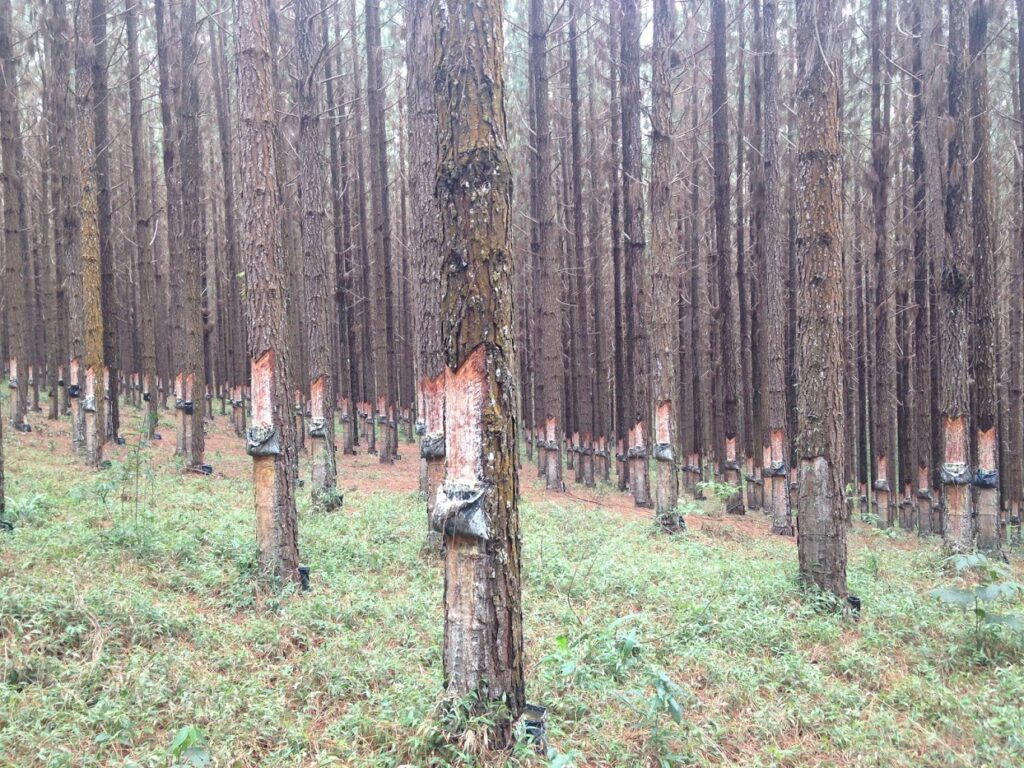
Genetically improved pine forest in Brazil

Europe has benefited from a rise in the price of resin over the last decade to increase its production, which was almost stopped, mainly in Spain and Portugal. At the same time, tapping activity restarted in France thanks to mechanisation with a strong value in niche markets. Production levels in Europe are still very low in comparison with world production and the activity remains subject to international competition. However, the growing demand for renewable and sustainable products from developed countries is likely to favour this market of low-carbon products in the future.

It seems that China’s growing demand for gum rosin and turpentine will not be offset by the growth of this sector in Brazil. Low stocks of rosin worldwide could lead to higher prices. At the same time, paper mill activity has decreased in Europe and the United States, leading to a reduction in the distillation of Tall oil (resin obtained as a by-product in paper production). As a result, the production of Tall oil rosin, a possible substitute for gum rosin, has decreased. Despite all these factors that are favourable to increased tapping, the sector will continue to be affected by competition from hydrocarbon resins, towards which China could move more in the future, depending on the evolution of the price of oil.

Author: Armand Clopeau (IEFC)


Link to the conjecture note

Navegación de entradas

Previous PostPrevious
Next PostNext

Archieves

  • noviembre 2025
  • junio 2025
  • mayo 2025
  • marzo 2025
  • enero 2025
  • Categories

  • Bioeconomia
  • Socios asociados
  • Miembros
  • Recent Posts

    • FIRE-RES: Una dinámica colectiva para reforzar la resiliencia frente a los incendios forestales en Europa y en las Landas de Gascuña
    • Introducción del nematodo del pino en Francia: ¿qué puede hacer la investigación?
    • Editorial 2026
    • Plantación de pino silvestre: uso de material mejorado sin perder la base genética
    • El IEFC, la red para los bosques plantados en el centro de todas las redes forestales

    Search

    ©IEFC Copyright ©2025 Tous droits réservés