
International trade data for oleoresin and the primary processing products rosin and turpentine are not always made transparent by the customs services of the different countries. Therefore, one of the objectives of the SustForest+ project is to offer a view on the evolution of the international market to European stakeholders of the pine oleoresin sector.
The COVID-19 pandemic had an impact on economies around the world and the resin market was not exempt. During the 2nd quarter of 2020, the GDP of most Western countries decreased while the one in China increased by 11.50%. While the volumes of resin and rosin exported to Europe decreased, exports to Asia increased significantly. Between the second quarter of 2020 and the second quarter of 2019, rosin exports from Brazil to China almost doubled.
This spectacular growth in the context of a health crisis is part of a deeper evolution of the Chinese economy. Over the last 20 years, the country has continuously reduced its production and participation as a global supplier of rosin and turpentine made from oleoresin. This decline is linked to the low productivity of the tapping systems used and the rapid increase in wages in China. Nevertheless, China has increased the share of processing of these raw materials internally, becoming an exporter of higher value-added processed products.
Meanwhile, Brazil has doubled its oleoresin production in the last 6 years thanks to the use of efficient techniques, genetic selection of pine trees for their resin productivity and the availability of cheap labour. The country has thus become the world’s leading exporter of oleoresin, rosin and turpentine.
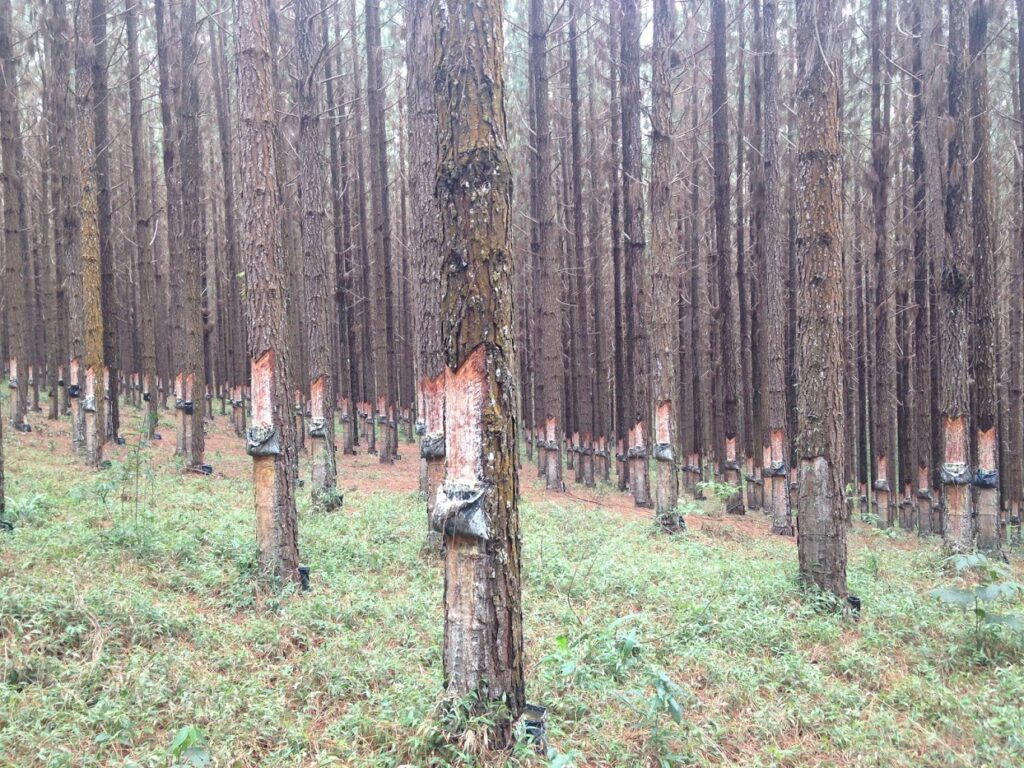
Europe has benefited from a rise in the price of resin over the last decade to increase its production, which was almost stopped, mainly in Spain and Portugal. At the same time, tapping activity restarted in France thanks to mechanisation with a strong value in niche markets. Production levels in Europe are still very low in comparison with world production and the activity remains subject to international competition. However, the growing demand for renewable and sustainable products from developed countries is likely to favour this market of low-carbon products in the future.
It seems that China’s growing demand for gum rosin and turpentine will not be offset by the growth of this sector in Brazil. Low stocks of rosin worldwide could lead to higher prices. At the same time, paper mill activity has decreased in Europe and the United States, leading to a reduction in the distillation of Tall oil (resin obtained as a by-product in paper production). As a result, the production of Tall oil rosin, a possible substitute for gum rosin, has decreased. Despite all these factors that are favourable to increased tapping, the sector will continue to be affected by competition from hydrocarbon resins, towards which China could move more in the future, depending on the evolution of the price of oil.
Author: Armand Clopeau (IEFC)